 info@marketbotics.co.uk
 +44 20 3769 3722
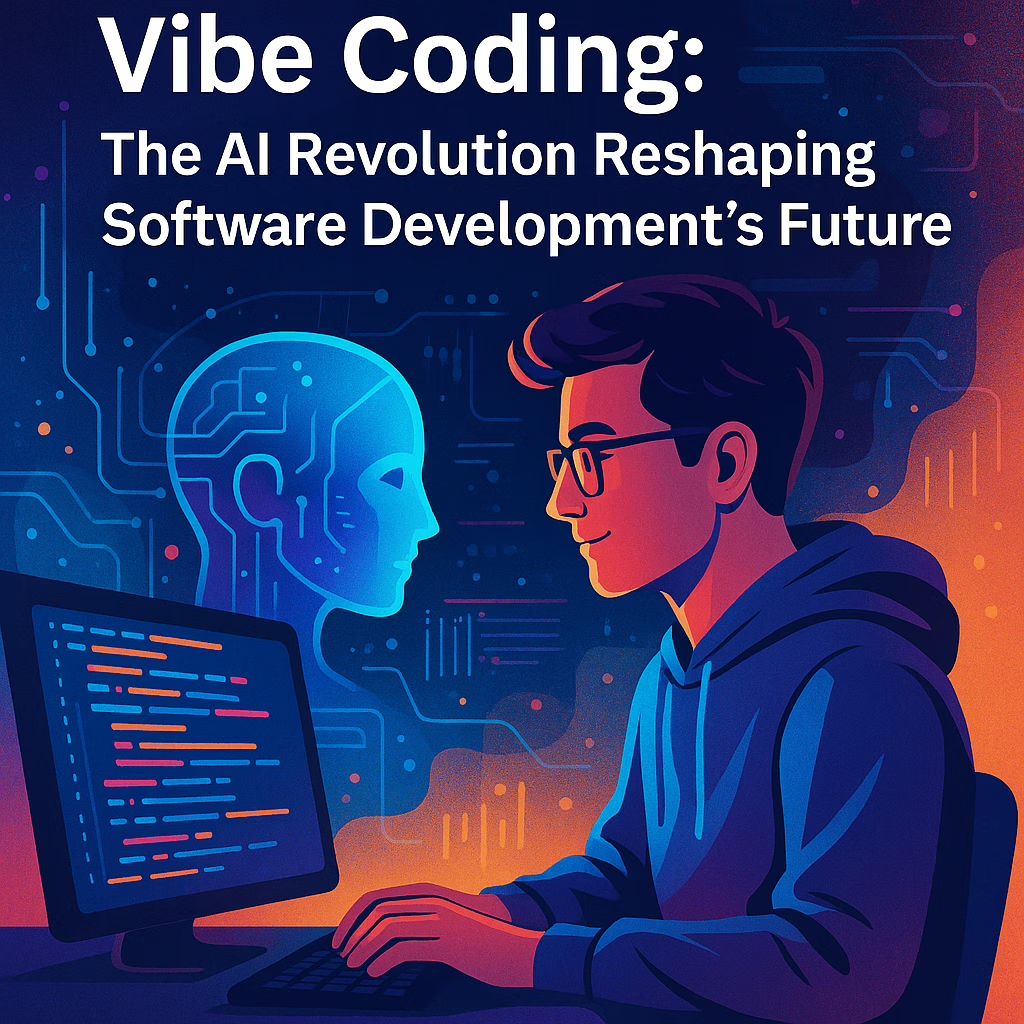
Introduction: More Than Just a Buzzword
In February 2025, AI pioneer Andrej Karpathy introduced a concept that would rapidly transform software development: “vibe coding.” Described as fully giving in to “the vibes,” embracing exponentials, and forgetting “that the code even exists,” this approach represents a fundamental shift in how humans create with technology . As Collins Dictionary’s Word of the Year for 2025, the term has transcended industry jargon to become a cultural touchpoint .
For professionals at the intersection of marketing and technology, understanding vibe coding isn’t just technical curiosity—it’s strategic imperative. At its core, vibe coding represents an AI-driven development approach where developers describe what they want in natural language, and large language models (LLMs) generate the corresponding code with minimal human intervention . The programmer’s role shifts from writing code to guiding, testing, and providing feedback through natural language instructions .
What Exactly is Vibe Coding? Beyond the Hype
Key Characteristics of the Vibe Coding Paradigm
Vibe coding represents a distinct departure from traditional software development methodologies:
- Natural Language First: Developers describe requirements in plain English rather than wrestling with syntax
- Output-Oriented Evaluation: Practitioners typically verify functionality through execution rather than code review
- Iterative Refinement: Continuous prompt adjustment replaces direct code editing
- AI as Primary Developer: The large language model handles the technical implementation
- Accessibility Focus: Dramatically lowers barriers to software creation
This approach fundamentally reimagines the developer’s role. As Karpathy famously noted, “the hottest new programming language is English,” suggesting that human programmers may increasingly focus on high-level direction rather than technical implementation .
The Vibe Coding Workflow in Practice
A typical vibe coding session follows a distinct pattern:
- Broad Prompt Initiation: Start with a high-level description like “build a signup form with validation”
- AI Code Generation: The LLM generates complete code blocks based on the request
- Result Verification: Check functionality in the browser or runtime environment
- Iterative Prompt Refinement: Provide follow-up instructions like “fix the button alignment” or “add error handling”
- Integration: Patch working code into the larger codebase
This workflow emphasises rapid experimentation over careful architecture, making it particularly suitable for exploratory phases of development.
Current Applications: Where Vibe Coding Excels Today
Ideal Use Cases
While vibe coding isn’t suitable for all development scenarios, it shines in several specific contexts:
- Rapid Prototyping & MVPs: Transform ideas into testable interfaces quickly, perfect for validating concepts without significant investment
- Marketing Landing Pages: Create polished, responsive pages that can be iterated on quickly based on campaign performance
- Interactive Microsites & Demos: Build engaging web experiences with dynamic visuals and animations without manual coding
- Personal Projects & Experiments: Lower the investment needed for hobby projects that wouldn’t justify traditional development time
- Learning & Skill Development: Provide instant feedback on how natural language ideas translate into working code
The Expanding Tool Ecosystem
The vibe coding revolution is powered by a growing ecosystem of sophisticated tools:
| Tool | Primary Strength | Best For |
| Cursor | Deep codebase integration | Professional developers working within existing projects |
| Replit | Browser-based rapid development | Beginners and education contexts |
| Windsurf | Anticipatory AI assistance | Developers preferring hands-off approach |
| Claude Code | Complex prompt understanding | Frontend work and detailed implementations |
| GitHub Copilot | Established ecosystem integration | Those already in Microsoft’s development ecosystem |
Limitations and Considerations: The Vibe Coding Balance Sheet
Current Challenges
Despite its promise, vibe coding faces significant hurdles in professional adoption:
- Security Vulnerabilities: AI-generated code may introduce security flaws, with one study identifying vulnerabilities in 170 out of 1,645 vibe-coded web applications
- Technical Debt Accumulation: The approach often prioritises speed over structure, creating messy, inconsistent codebases that become difficult to maintain
- Debugging Complexity: When AI-generated code fails, developers may lack the context to efficiently troubleshoot
- Context Loss: In extended sessions, LLMs can forget earlier instructions, leading to inconsistent implementations
- Scalability Limitations: The approach struggles with complex, multi-file projects requiring coherent architecture
The Expertise Paradox
Vibe coding creates an interesting paradox: while it lowers barriers to entry, it often works best when guided by experienced developers who can recognise problematic patterns and validate outputs. As one developer notes, “If an LLM wrote every line of your code, but you’ve reviewed, tested, and understood it all, that’s not vibe coding in my book—that’s using an LLM as a typing assistant” .
The Future Trajectory: Where Vibe Coding is Headed
Emerging Trends for 2025 and Beyond
The evolution of vibe coding points toward several significant developments:
- Autonomous Feature Development: AI agents will progress from generating snippets to planning, building, testing, and refactoring complete features with minimal human input
- Lightweight Architecture Emphasis: Development will trend toward leaner frameworks and simpler architectures optimised for AI generation and maintenance
- Security Integration: Security tooling will shift from suggestive to corrective, automatically remediating vulnerabilities in AI-generated code
- Real-Time Feedback Expansion: IDE-native assistants will surface performance issues, architectural inconsistencies, and compliance violations as code is generated
- Cross-Domain Application: The “vibe” methodology is already spreading to adjacent fields like “vibe marketing” and “vibe valuation”
Strategic Implications for Organisations
For businesses monitoring this space, several strategic considerations emerge:
- Developer Workflow Evolution: Engineering organisations must adapt processes, quality gates, and review practices for AI-generated code
- Toolchain Governance: Organisations need visibility and policy controls as developers experiment with unvetted AI tools that may bypass security protocols
- Skill Development Rebalancing: Training focus may shift from syntax mastery to prompt crafting, system architecture, and AI output validation
- Technical Debt Management: Companies should establish explicit policies for when vibe-coded prototypes must be rebuilt with traditional methods
Conclusion: Embracing the Vibe Responsibly
Vibe coding represents more than a productivity enhancement—it signals a fundamental shift in the relationship between human intention and software implementation. While the approach shows remarkable promise for prototyping, experimentation, and specific production applications, it complements rather than replaces traditional software engineering expertise.
The organisations that will thrive in this new paradigm are those that strike a balance: embracing the speed and accessibility of vibe coding while maintaining robust practices for security, architecture, and maintenance. As the technology continues its rapid evolution, the most successful developers and teams will be those who adapt their skills to guide AI systems effectively while retaining the critical thinking and architectural understanding necessary to build software that is not just functional, but secure, maintainable, and scalable.
For Marketbotics and other technology-forward organisations, the message is clear: vibe coding is worth exploring strategically, with clear guidelines about its appropriate applications and limitations. The future belongs to those who can harness its power without succumbing to its pitfalls.
Marketbotics helps organisations navigate the evolving landscape of AI-enabled development and digital marketing. Follow us for more insights on leveraging emerging technologies for business advantage.